
Discover how Community Mental Health Services promote inclusion, support recovery, reduce stigma, and help individuals thrive within their communities
Community mental health refers to providing mental health care among community environments, as opposed to providing it in isolation or institutions.This care aims at providing accessible and client-centered mental wellness care that helps people address their mental wellness. Even though they still engage with their families, working environments, and social structures.
Community mental wellness care may involve counseling, outreach, crisis interventions, or mental wellness rehabilitation. The importance of these services currently can be determined as they support mental health, recovery, or inclusion as a means of encouraging individuals to be part of their communities.
This is without inhibitions by providing them with care that is within their reach. Therefore, this assists them in attaining a sense of purpose by feeling valued, wanted, and empowered as they live their lives to the full. This blog will explore how community mental health services providers support inclusion mental health and recovery.
What Is Community Mental Health?
Community mental health is that form of approach toward mental health care in which services are delivered within a person’s community rather than in long-term institutional settings. It ensures access to services, holistic support, and person-centeredness that empowers individuals to continue with their daily life while managing their mental health challenges.
These services are reinforced by a purpose and aim toward well-being and recovery, and social inclusion by not only attending to clinical needs but also the social and emotional or practical aspects of the person’s lives.
Community Mental Health vs. Institutional Care
Community mental health explained with the help of an example by comparison with institutional care:
- In institutional care, treatment is generally in hospitals and institutions, and is often related to acute mental illness and does not relate to community life.
- Community-based services for mental health can provide services in clinics, homes, schools, or community centers, so the patient maintains continuity with the rest of the world.
- Community mental health care is based on the principles of independence, recovery, and inclusion, in contrast to the principles that guide institutions.
Who Do Community Mental Health Services Support?
Community mental health services help many people, including:
- Those with mild to severe mental health issues.
- Those people who are in the recovery process of mental illness and who get reintegrated into their community environment such as children, adolescents, adults, older adults or seniors.
- Families and caregivers needing guidance and support.
What Are Community-Based Mental Health Services?
Community based mental health services are interventions and support meant to assist people cope with their mental issues even when living and engaging with the wider community. Accessibility, continuity of care, and recovery are the key aspects of these services to ensure that mental health support is available beyond health institutions.
Types of Community Based Mental Health Services
Community based mental health services deliver a wide range of support, including:
Counseling and Therapy
Counselling or therapy for community groups or individuals and their families with the goal of supporting them to cope with their emotional and mental issues. All of the interventions occur in community clinics, schools, or some other nonprofit organizations.
Case Management
Person-centered service facilitation that supports individuals in accessing health care, housing, jobs, and social services and assures continuousness and coordination of care.
Crisis Intervention
Providing immediate, often hotline, mobile crisis team, and emergency community service support for individuals in a mental crisis.
Peer Support Programs
Personal or peer support services offered by individuals who have had personal experience with mental health issues, as well as encouragement, comprehension, and advice associated with the recovery process.
The Delivery of Community-Based Services for Mental Health
Mental health services offered at the community level are offered by local systems, which are designed to be highly accessible. Services are offered in mental healthcare centers, homes, schools, work, or outreach programs. Making mental healthcare readily available to the local populations, mental health services offered by the community help alleviate barriers, improve social networks, and facilitate mental healthcare inclusion.
Promoting Inclusion Through Community Mental Health
Community mental health services play an important role to promote the concept of inclusion by encouraging people with mental health problems. This leads to a life that enables them to learn, work, and participate in society with full equality. Community services for the mentally ill have the role of promoting the concept of mentally ill people.
They feel accepted and valued in society by the provision of services in the community, with the aim of changing the behavior and perceptions towards the mentally ill. They also have the role of promoting equality and eliminating isolation. Moreover, these services make productive participation possible in education, employment, and social life.
This happens through counseling, workplace accommodation, academic place, and the possibility of participation in cultural and community life. These are the services which allow inclusive, person-centered approaches, respectful of strengths, preferences, and cultural backgrounds of individuals. This empowers and offers them dignity and lasting inclusion and recovery in the community. Moreover, these employment services in Texas enable productive participation in the workforce, enhance job readiness, career growth, and workplace integration.
Supporting Recovery-Oriented Mental Health Care
Healing or recovery in mental health treatment is more about personal, continuous efforts towards developing a significant and satisfactory life. The community mental health facilities assist in the healing process through flexible and client-center-based services that match the objectives, capabilities, and values of the client.
Through empowerment, autonomy, and the ability for self-determination, and also through support structures within the community, the client is in a position to make positive decisions, build coping mechanisms, and maintain social relationships, thereby developing long-run wellness.
Benefits of Community Mental Health Services
Peer support services in mental health recovery also support connections by fostering understanding, common experiences, and mutual inspiration. Community mental health services deliver several advantages that improve the well-being of individuals and strengthen communities such as:
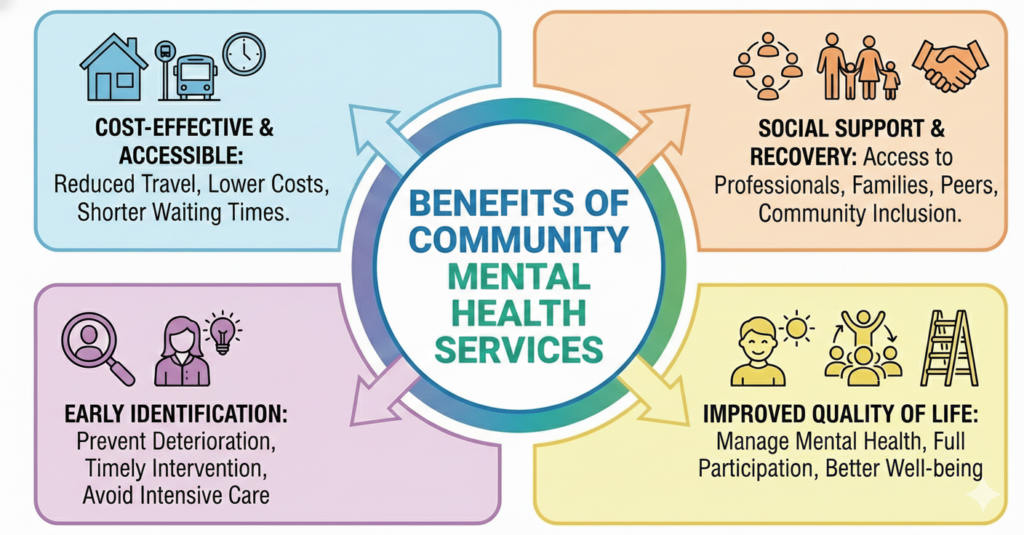
- The services are cost-effective and within reach of the home which overcomes difficulties in relation to travel, cost of services, and waiting time.
- These services are useful to identify any mental health concerns early to avoid deteriorating and needing intensive care.
- These services provide individuals access to health professionals, families, peers, as well as the community that assists them to complete the process of inclusion, mental health and recovery.
- This care helps individuals manage their mental health, participate fully in community life that leads them to a better overall quality of life.
Challenges in Community Mental Health Services
Although the advantages of community mental health services are considerable, some factors might hinder the effectiveness of these services such as:
Insufficient Funds and Resources
In fact, some community-based mental health facilities often have resource limited budgets, which might restrict access to health care and the level of care received by patients as well.
Labor Shortages
There is a common shortage of trained or expert mental health professionals such as therapists, counselors, and social workers. This creates a challenge in addressing the rise in demand for services.
Stigma and Social Barriers
Despite the level of awareness having increased, the associated stigma with mental illness has been an obstacle that prevents people from seeking treatment. In addition to that, social and cultural factors could preclude people from the marginalized community from seeking treatment.
Demand Inclusive Policies
A community mental health system is one that would have policies that are inclusive, promoting, and accessible on grounds of equity. People might not get good mental support without such supportive programs.
The Future of Community-Based Mental Health Care
The future of community-based mental health care is about developing an integrated and accessible health care system to cater to the different needs of communities. The future involves integrating mental health and primary health care, increasing accessibility through technology, and working towards a higher sense of inclusion and equity through culturally appropriate support services. The future also incorporates community participation to ensure that health care is relevant, enabling, and responsive to communities to build strong and resilient communities.
How Diadem Heart Supports Community Mental Health
Community mental health services are a critical factor in the stimulation and achievement of the objectives of inclusion, recovery, and general well-being. Organizations, such as Diadem Heart, specifically work towards supporting these objectives by providing various community mental health services. Diadem Heart reaches the objectives through the provision of various community mental health services that include counseling, peer support, and outreach services. Diadem Heart specifically works towards the development and achievement of the objectives through the stimulation of various community mental health services, including the reduction, via awareness, the strengthening, through the development of social connections, and empowerment, through mental well-being, objectives.
FAQs
What is Community Mental Health?
The community mental health center provides easily accessible support that gives individuals a chance to preserve their mental health without ever leaving their community.
What are community-based mental health services?
These would include counseling, crisis support, and peer programs provided within communities rather than in institutions.
How does a community mental health service promote inclusion?
They support by decreasing stigma, encourage participation in education, employment, and society, as well as personalized care.
What does recovery-oriented mental healthcare mean?
It emphasizes independence, empowerment, and the establishment of a momentous life, as opposed to just managing symptoms.
Why are community mental health services important?
They improve and advance access, strengthen support networks, enable early intervention, and develop overall quality of life.